


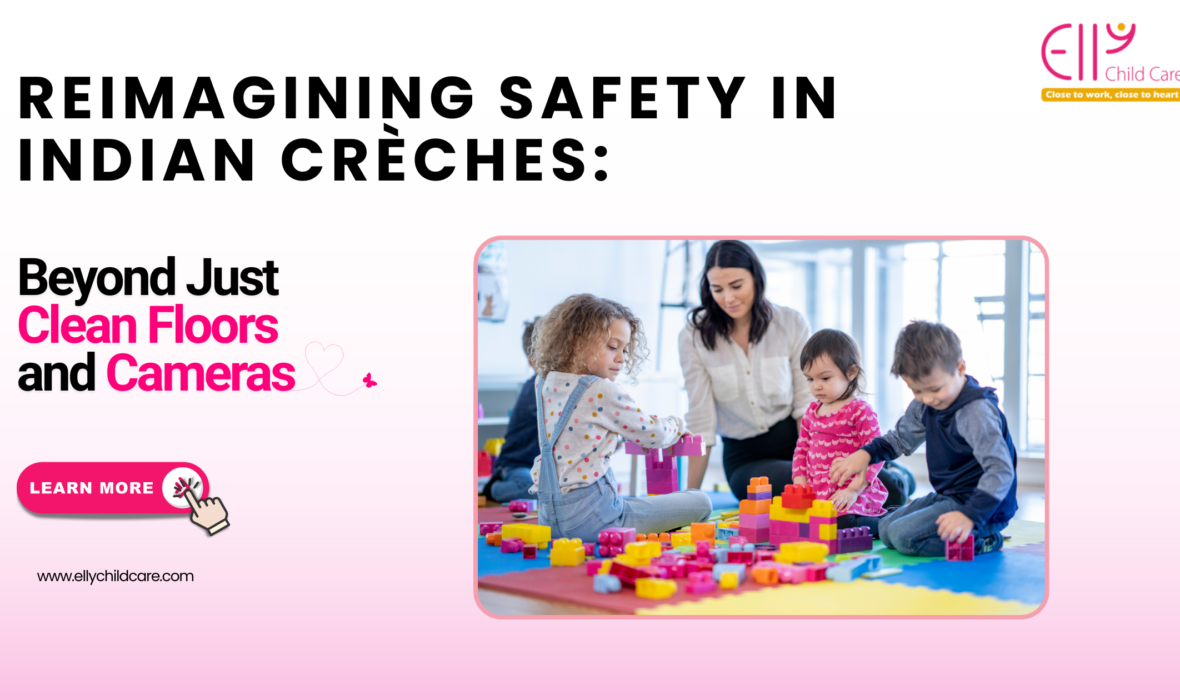
When parents drop their child off at a crèche each morning, they are doing more than handing over a lunchbox and waving goodbye. They are entrusting that space- and the people in it- with their child’s well-being, both physical and emotional.
In India, where the early childhood care sector is growing rapidly, “safety” is often treated as a checklist: CCTV cameras, biometric entry, child locks, and clean bathrooms. While these are important, proper safety runs deeper. It is not just about infrastructure—it’s about culture, systems, and care.
This blog provides a closer look at what a truly safe childcare environment means in the Indian context and what working parents, HR teams, and crèche providers should actively seek.
1. Background Checks and Staffing Policies: Trust Begins with People
Safety starts with the adults in the room.
In India, many childcare providers operate informally or with minimal oversight. A crèche’s approach to hiring should include:
– Police verification of all staff, including teachers, helpers, and support staff.
– Reference checks from previous employers or clients.
– Regular retraining and evaluation, notjust atinduction.
Caregivers must not only be qualified but also emotionally attuned, patient, and consistent in their approach. A revolving door of staff is a red flag—young children need predictability and trusted adults to feel secure.
2. Physical Safety: Infrastructure That Understands Children
Safe spaces are intentionally designed for the age and developmental stage of the children.
Look for:
– Low shelves and soft corners, not sharp furniture.
– Child-sized toilets, clean diapering stations, and hygienic handwashing routines.
– Secure gates and supervised exits—no child should be able to leave unnoticed.
– Electrical sockets should be covered, staircases should be gated, and all play materials should be non-toxic and age-appropriate.
While these may seem like basic standards, in India, many centres still operate in repurposed apartments or unused office spaces; aesthetics must never take precedence over safety.
3. Hygiene Practices: A Daily, Visible Commitment
In a post-COVID world, hygiene is non-negotiable—but it’s not just about sanitizer dispensers.
Parents should ask:
– Are surfaces cleaned daily with child-safe disinfectants?
– Are toys and learning materials sanitized regularly?
– Do children follow handwashing routines before meals and after using the bathroom?
-Is there a clear illness policy in place to prevent the spread of infection?
Crèches should also train their staff in basic health protocols, including recognizing signs of fever, dehydration, or food allergies and responding appropriately.
4. Supervision and Ratios: Eyes Always on the Child
Young children need more than just physical presence—they need engaged supervision.
The recommended adult-to-child ratios vary by age:
–Infants (under 1 year): 1 adult for every 3–4 Children
– Toddlers (1–2 years): 1 adult for every 5–6 Children
– Preschoolers (3–5 years): 1 adult for every 8–10 Children
In India, where these ratios are not strictly enforced, overcrowded or understaffed centers can lead to neglect or accidents. A safe crèche ensures that:
– Every child is visible, known, and accounted for at all times.
– There are no unsupervised areas or “blind spots” in the classroom or playground.
– Children are never left alone, not even for short intervals
5. Safeguarding Policies: Protection Beyond Accidents
Safety also means protection from abuse, neglect, or emotional harm—an area often overlooked in Indian childcare settings.
Ask if the crèche has:
– A Child Protection Policy in line with the POCSO Act (2012).
– A designated Internal Complaints Committee orpointperson for concerns.
– Mandatory reporting protocols are in place for any suspicion of harm.
– Regular training for staff on boundaries, consent, and child-friendly behavior.
Children are not always able to express their discomfort verbally. A culture of listening, observation, and open communication is essential.
6. Emergency Preparedness: Planning for the Unexpected
Whether it’s a fire, medical emergency, or even a natural disaster, staff must be prepared to act swiftly and calmly.
Minimum requirements include:
– First aid kits are accessible in every room.
– At least one staff member trained in CPR and pediatric first aid.
– Fire extinguishers, safety drills, and evacuation maps.
– Clear communication plans with parents in the event of emergencies.
– Emotional Safety: The Often-Overlooked Piece
Lastly—and just as critically—children must feel emotionally safe. This means:
– They are never shamed, yelled at, or left out.
– Their feelings are acknowledged and responded to with empathy.
– Teachers use positive discipline strategies and respectful communication.
A child who feels emotionally safe is more likely to thrive, take healthy risks, and develop strong social-emotional skills. Emotional safety is not an add-on—it’s foundational.
In Conclusion, Safety Is a System, Not a Feature
Choosing a crèche is not just a logistical decision—it’s a profoundly emotional one. And for employers, providing on-site childcare is not just a perk—it’s a responsibility.
In India, where the early childhood sector is still formalizing its standards, we need to move beyond buzzwords like “safe” or “nurturing” and ask: What do those words look like in practice? Who is ensuring they are upheld every day?
Parents have the right to ask questions. Providers have the responsibility to answer them. And children—above all—have the right to environments where they are not just looked after but honestly protected.