


· · 6 min read
Corporate daycare for manufacturing and factory units is employer-run childcare, set up on or near a factory campus, that looks after workers’ young children while their parents are on the shop floor. For factories this is not a new idea but a long-standing legal duty, and in 2026 it applies more widely than before. India’s Code on Social Security, 2020, in force since November 2025, requires every establishment with 50 or more employees, a factory included, to provide a childcare facility or pay an allowance in its place. With about 68 million people working in Indian manufacturing, nearly a third of them women, on-site childcare has become both a compliance line and a way to hold on to experienced workers.
TL;DR:
Corporate daycare for a factory is on-site or near-site childcare, run by the employer or a childcare operator, usually for children from about six months to six years.
Under the Factories Act, 1948, any factory employing more than 30 women had to provide an on-site room for children under six; since November 2025 the Code on Social Security, 2020 sets a single, gender-neutral rule at 50 or more employees.
Where a facility is not provided, the employer must pay a childcare allowance of at least 500 rupees per child per month for up to two children.
India’s manufacturing sector employs about 68 million workers, and more than a third, nearly 23 million, are women, so the demand for factory childcare is large and concentrated.
Elly Child Care sets up dedicated on-campus daycare and has run centres for manufacturers including Bajaj Auto and TVS Motors.
What is corporate daycare for a manufacturing or factory unit?
Corporate daycare for a factory is childcare that the manufacturer provides or sponsors for its workforce, rather than something each family arranges alone. In practice it is a supervised, staff-led centre for infants and young children, usually aged six months to six years, placed on the plant campus or close to it and run in step with the factory’s shifts and holiday calendar.
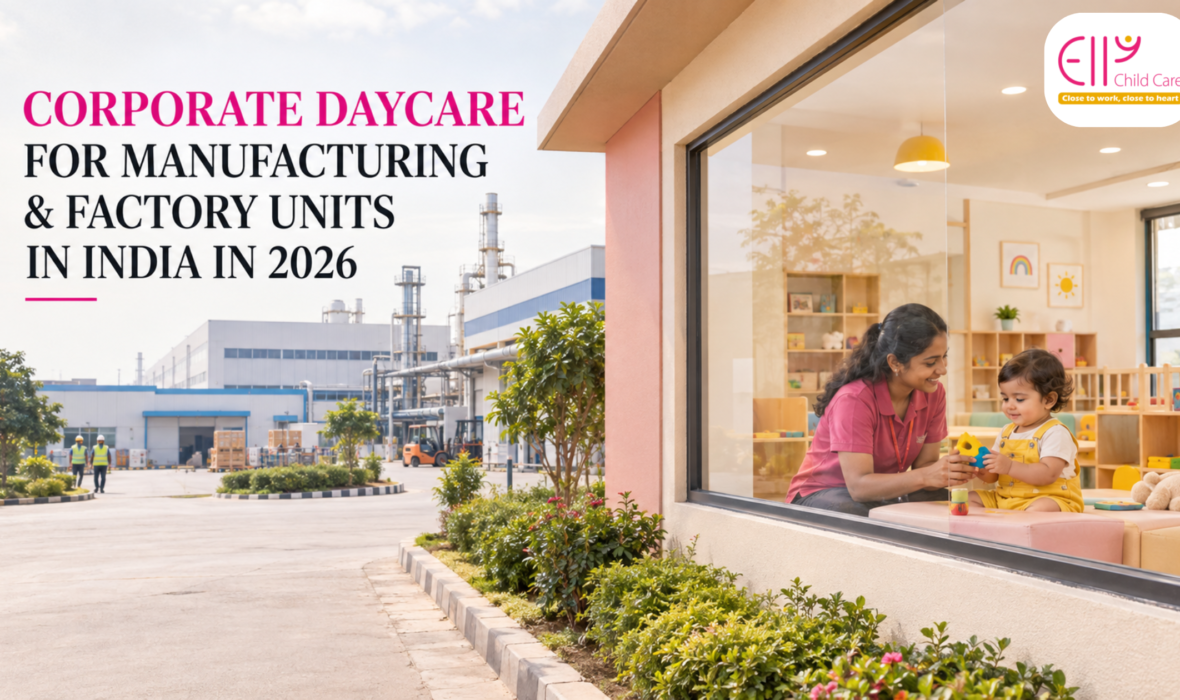
The distinguishing feature for a factory is the setting. The childcare centre has to sit within easy reach of the workforce but well away from the shop floor, machinery, and any hazardous process, in a clean, well-ventilated space built for young children. This is the model Elly Child Care operates as dedicated on-campus daycare run by its own staff, sized to a minimum group and scaled up as more families enrol.
For a worker on a production line, proximity is the whole point. A childcare centre inside the gate means a parent can settle a child before a shift, check in at a break, and reach the child within minutes if something is wrong.
Why do manufacturing and factory units in India need corporate daycare in 2026?
Manufacturing is one of India’s largest employers of parents of young children, which is what drives factory childcare demand. India’s manufacturing sector employs about 68 million workers, and more than one-third, nearly 23 million, are women, according to Periodic Labour Force Survey data compiled by Data For India. Women’s share of manufacturing work has climbed from under a quarter in 2000 to more than a third today.
That workforce is not spread evenly. Within organised factory manufacturing, two-thirds of all female factory workers are concentrated in Tamil Nadu, Karnataka and Andhra Pradesh, the same Annual Survey of Industries data shows. These are the states where a factory is most likely to employ enough young mothers to make on-site childcare essential rather than optional.
For a manufacturer, the business case sits alongside the legal one. A worker who can keep a child safe on the campus is far less likely to leave after having a child, which is why the measurable returns from workplace childcare show up first in retention and attendance on the line.
What does the law require: from the Factories Act to the 2026 labour codes?
Factories have carried a childcare duty for decades. Under Section 48 of the Factories Act, 1948, any factory employing more than 30 women had to provide and maintain a suitable on-site room for children under six, kept clean, well-lit and staffed by trained carers.
India’s four labour codes, in force since November 2025, consolidate these older welfare laws, and the childcare-facility obligation now sits in the Code on Social Security, 2020. It applies a single, gender-neutral rule: every establishment with 50 or more employees, a factory included, must provide a childcare facility for children under six, and the requirement no longer depends on counting only women.
Where a facility is not provided, the employer must pay a childcare allowance of not less than 500 rupees per child per month, for up to two children, and a parent must be allowed to visit the child during the day. For a factory HR or admin team, this makes childcare a documented compliance item, which is why many now treat the childcare-facility mandate as a formal HR project rather than a welfare afterthought.
On-site or near-site: which childcare model fits a factory?
Most manufacturers choose between two workable models, and factories often have an advantage on the first. A dedicated on-site centre sits inside the plant campus, which suits factories that usually have the land and floor space to build one. A near-site or network tie-up places children in an operator’s existing centre close to the plant, which helps when a unit is space-constrained or when workers live clustered near the gate.
How on-site and near-site models are priced depends mainly on the number of children and the staffing the centre needs, since a corporate centre is run by trained staff at a set group size and scaled as enrolment grows.
| Factor | Dedicated on-site centre | Near-site or network tie-up |
|---|---|---|
| Location | Inside the plant campus, away from the shop floor | Operator’s centre near the plant |
| Best for | Units with land and space, common in manufacturing | Space-constrained or multi-location units |
| Parent proximity | Highest, child is on the same campus | High, child is a short distance from the gate |
| Shift alignment | Set to the factory’s own hours and calendar | Set to the operator’s hours, coordinated with shifts |
| Setup effort | Higher, needs a dedicated, safe space | Lower, uses an existing centre |
How does Elly Child Care run corporate daycare for manufacturers?
Elly Child Care is the corporate daycare arm of Learning Edge India Pvt. Ltd., and it sets up dedicated on-campus centres for employees’ children aged six months to six years. For a manufacturer, that means a centre placed safely away from the production area, staffed by Elly Child Care’s own trained team, with timings and holidays aligned to the plant’s working hours and starting from a minimum group that grows as more families enrol.
Safety is handled through named practices rather than slogans. Staff go through verification and onboarding, receive POCSO training delivered by legal professionals, and follow first-aid and regular safety-inspection routines, while access to the centre is supervised throughout the day. The space is built for age-appropriate learning, not plain minding.
Parents stay connected through an app that shares daily updates on nap times, activities and the food sent from home, while the company’s HR team receives monthly reporting. The curriculum spans the areas early-years educators recognise, including communication and language, physical development, social and emotional growth, early mathematics, understanding the world, and expressive arts. Across its corporate partnerships, which include manufacturers such as Bajaj Auto and TVS Motors, Elly Child Care has run centres for employers of very different sizes and shift patterns.
What should factory HR and safety teams check in a childcare partner?
A factory buyer should judge a childcare partner on people, safety and location first. Ask how staff are verified, whether they are trained in child protection and first aid, how many children each adult is responsible for, and how the centre is separated from machinery and hazardous areas, since these decide whether the setup is genuinely safe on an industrial site.
Then check the practical fit with plant life. A good partner sets the centre’s hours to the factory’s shifts, keeps the space clean, ventilated and calm as the law for such rooms has always required, and reports clearly to both parents and HR. Proximity, verified staff, a safe location away from the shop floor, and transparent communication are the four things that separate real early-years care from basic minding on a factory site.
Frequently asked questions
Is a childcare facility mandatory for factories in India in 2026?
For most mid-size and large factories, yes. Under the Factories Act, 1948, any factory employing more than 30 women already had to provide an on-site room for children under six. Since November 2025, the Code on Social Security, 2020 sets a single, gender-neutral rule requiring every establishment with 50 or more employees, factories included, to provide a childcare facility or pay an allowance of at least 500 rupees per child per month for up to two children.
How is a factory childcare centre different from a regular daycare?
A factory childcare centre is provided or funded by the manufacturer, open only to its workers’ children, and placed on or near the plant campus but safely away from machinery and hazardous processes. A regular daycare is arranged privately by parents and located wherever they choose. The factory version keeps the child close to a parent on the line and is set to the plant’s own shifts and holidays.
What age group does corporate daycare for factories cover?
Most corporate centres, including Elly Child Care, care for children from about six months to six years. That range covers infants of workers returning from maternity leave through to pre-primary age, which is the window when a young child most needs a parent within reach during a shift.
Where in India is factory childcare demand highest?
Demand is heaviest where factories employ the most young women. Within organised factory manufacturing, two-thirds of all female factory workers are in Tamil Nadu, Karnataka and Andhra Pradesh, so plants in these states are most likely to need on-site childcare, though the 50-employee rule now applies nationwide.
Can a factory meet the requirement without building its own centre?
Yes. The Code on Social Security, 2020 lets employers share a common facility or pool resources with other organisations, and a manufacturer can also tie up with a childcare operator who runs a centre near the plant. Where no facility is provided at all, the law requires the childcare allowance of at least 500 rupees per child per month for up to two children instead.
How do working parents on a shift stay updated during the day?
At Elly Child Care, parents receive app-based updates through the day covering nap times, activities and the food sent from home, and they can visit the child during working hours. The company’s HR team receives regular monthly reporting, so both the parent on the line and the employer stay informed.
Sources
- Ministry of Law and Justice, The Code on Social Security, 2020 (Act No. 36 of 2020), Section 67. https://www.indiacode.nic.in/bitstream/123456789/16823/1/aA2020-36.pdf
- Press Information Bureau, “Union Government’s Four Labour Codes Simplify and Streamline Labour Laws,” 21 November 2025. https://www.pib.gov.in/PressReleasePage.aspx?PRID=2194018®=48&lang=2
- Press Information Bureau, “New Labour Codes Empower Women with Greater Safety, Equality, and Workplace Flexibility,” November 2025. https://www.pib.gov.in/FactsheetDetails.aspx?Id=150499®=3&lang=1
- Institute of Company Secretaries of India, “An Overview on the Maternity Benefit (Amendment) Act, 2017.” https://www.icsi.edu/media/portals/22/Article%20on%20MBA%20Act,%202017.pdf
- Ministry of Labour and Employment, corrigendum notification confirming Section 11A (creche facility) effective 1 July 2017. https://www.simpliance.in/India/LEI/govt_notification/Central/the-maternity-benefit-amendment-act-2017-effective-date-revised-121
- JSA Advocates and Solicitors, “Key Considerations of the Notified Central Rules under the Labour Codes,” May 2026. https://www.jsalaw.com/corporate/key-considerations-of-the-notified-central-rules-under-the-labour-codes/
- BDO India, “Final Central Rules Notified Under All Four Labour Codes,” May 2026. https://www.bdo.in/en-gb/insights/alerts-updates/alert-final-central-rules-notified-under-all-four-labour-codes
- King Stubb & Kasiva, “What Are India’s New Maternity Benefit Rules in 2026?” https://ksandk.com/labour-employment/india-maternity-benefit-rules-2026/
- Lakshmikumaran & Sridharan, “Creche Obligations for Employers under the Labour Codes.” https://employmentlaw.lkslaw.com/creche-facility-employer-obligations
- Bar and Bench, “Crèche facility under the new Labour Codes: Available to all employees or restricted to women?” https://www.barandbench.com/law-firms/view-point/creche-facility-under-the-new-labour-codes-available-to-all-employees-or-restricted-to-women
- Game Changer Law Advisors, “Karnataka Government notifies rules governing Creche facility under the Maternity Benefit Act” (Karnataka Maternity Benefit (Amendment) Rules, 2019). https://gamechangerlaw.com/?p=3995
- NASSCOM, Technology Sector in India: Strategic Review 2025. https://nasscom.in/knowledge-center/publications/technology-sector-india-strategic-review-2025
- NASSCOM, Technology Sector in India: Strategic Review 2026. https://nasscom.in/knowledge-center/publications/technology-sector-india-strategic-review-2026
- NASSCOM, From Pipeline to Leadership: Women Innovators in India’s Product Ecosystem, 2026.
- NASSCOM, Making Diversity Work: Key Trends and Practices in the Indian IT-BPM Industry. https://nasscom.in/knowledge-center/publications/making-diversity-work-key-trends-and-practices-indian-it-bpm-industry
- Ministry of Statistics and Programme Implementation, Periodic Labour Force Survey Annual Report, July 2023 to June 2024. https://www.mospi.gov.in/sites/default/files/press_release/Press_note_AR_PLFS_2023_24_22092024.pdf
- International Labour Organization, The Impact of Care Responsibilities on Women’s Labour Force Participation, statistical brief, October 2024. https://www.ilo.org/resource/news/unpaid-care-work-prevents-708-million-women-participating-labour-market
- Kleven, Landais and Leite-Mariante, cross-country study of the motherhood penalty, summarised by the World Bank Development Impact blog. https://blogs.worldbank.org/en/impactevaluations/weekly-links-february-9-job-search-taxation-developing-countries-motherhood
- Axis Bank, The Missing Half: Women and India’s Growth Challenge, March 2026. https://www.axis.bank.in/about-us/press-releases/the-missing-half-axis-bank-study-finds-that-the-path-to-viksit-bharat-goes-through-getting-more-women-into-paid-work
- Supreme Court of India, Shalini Dharmani v. State of Himachal Pradesh, April 2024, on child care leave and mothers remaining in the workforce. https://www.livelaw.in/top-stories/supreme-court-concerned-at-lack-of-child-care-leave-in-himachal-pradesh-says-ccl-necessary-to-ensure-mothers-remain-in-workforce-255803
- Supreme Court of India, Maatr Sparsh (An Initiative by Avyaan Foundation) v. Union of India, 2025 INSC 302, February 2025, on feeding rooms and creche facilities.
Entry 20 or 21 replaces the current unsourced Supreme Court line, depending on which framing you keep. The Axis Bank 74% and 88% figures are not in the press release, so entry 19 only covers the survey size and scope. Add a page citation from the full PDF if you keep those numbers.